 AI-First Culture
Top 7 Reasons D365 Business Central is the Preferred ERP for Scaling North American Businesses
Summary
As businesses scale, legacy ERP systems create gaps in visibility, control, and compliance. This blog explains how Dynamics 365 Business Central supports North American growth with unified data, cloud scalability, and AI-driven capabilities for better decision-making.
Your ERP was built for the company you were, not the one you’re becoming.
As mid-market businesses scale across North America, that gap becomes harder to ignore. Multiple entities start operating in silos; finance teams spend more time on reconciliations, and compliance requirements vary across regions. At the same time, leadership is often forced to make decisions with incomplete or delayed data.
This strain is not accidental; it reflects a broader shift in how ERP systems are expected to function. According to Gartner, by 2027, 62% of ERP application spending will include AI capabilities, up from just 14% in 2024. This signals a clear move toward more connected, intelligent, and cloud-based platforms that can support real-time decision-making.
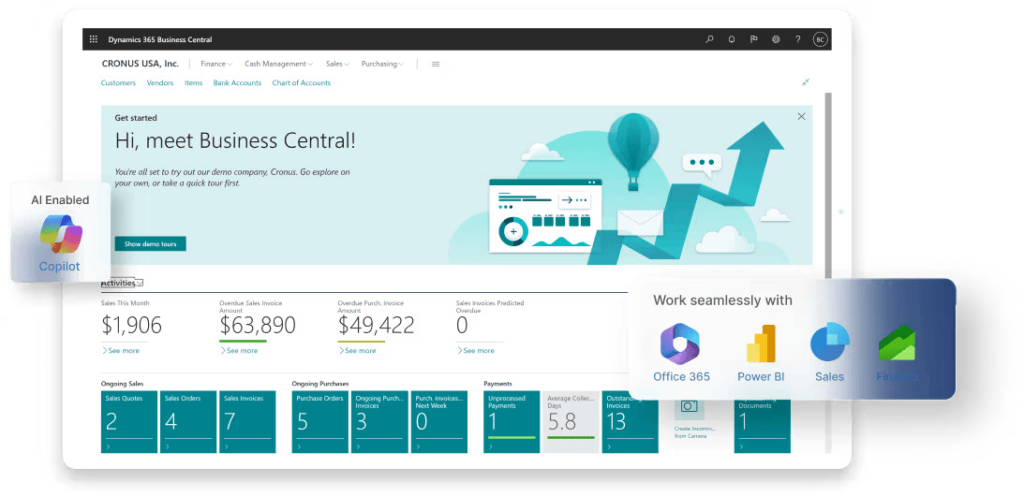
Microsoft Dynamics 365 Business Central is emerging as the leading platform supporting over 50,000 businesses today. It brings together cloud scalability, automation, and unified financial and operational data in a single system.
So, what makes it particularly well-suited for scaling North American operations?
The Scalability Imperative for North American Growth
Scaling across North America introduces a different level of complexity, and it compounds fast. Multi-entity structures, cross-border compliance, and operations across time zones quickly turn simple processes into interconnected workflows.
That's where existing systems begin to fall behind:
- Multi-entity reporting turns into a manual, error-prone monthly exercise
- Cross-border compliance requires constant workarounds across disconnected tools
- Leadership decisions rely on lagging, inconsistent data
This is the scalability gap.
Microsoft Dynamics 365 Business Central is designed to bridge it. By bringing financials, operations, and reporting into a single unified system, it enables organizations to manage multiple entities, standardize processes across regions, and access real-time data without fragmented tools.
This is where its cloud-first architecture plays a critical role.
1. Cloud-First Architecture Built for Scale
Cloud ERP is no longer a future consideration. According to Gartner, by 2028, cloud computing will shift from a competitive advantage to a business necessity, and for scaling mid-market businesses, that shift is already underway.
Microsoft Dynamics 365 Business Central is built on Microsoft Azure, which means scaling operations doesn't require scaling infrastructure.
In practice, this enables:
- Seamless multi-location deployments without added hardware or IT overhead
- Real-time access to data across time zones and distributed teams
- Continuous updates, including AI and automation enhancements
- High availability with enterprise-grade security
No upgrade projects. No version lock. Just a platform that grows with your business.
2. Unified Data and Operational Visibility
The scalability gap isn't just an ERP problem; it's a data problem. When finance, operations, inventory, and sales run on separate systems, every report becomes a reconciliation exercise, and every decision comes with an asterisk.
D365 Business Central eliminates that by centralizing data across all functions into a single source of truth.
What changes when teams actually work this way:
- A finance leader managing three entities closes the books in days, not weeks, because intercompany transactions reconcile automatically
- An operations lead spots an inventory shortfall before it impacts fulfillment, because purchasing and warehouse data live in the same system
- A CEO reviewing monthly performance works from one dashboard instead of waiting for four department reports to land in their inbox
The result is not just faster reporting. It is decision-making that reflects what is actually happening in the business, right now.
3. Seamless Integration with the Microsoft Ecosystem
Most mid-market teams already use Microsoft 365 every day. D365 Business Central fits right into that environment.
Instead of forcing teams into a new system, it connects directly with the tools they already rely on:
- Outlook for managing purchase orders and approvals without switching tabs
- Excel for financial analysis with live ERP data, no manual exports
- Teams for collaborative approvals and cross-department workflows
- Power BI for real-time dashboards built on a single data source
This integration reduces the learning curve and accelerates adoption across the organization. Teams can work more efficiently without changing how they work, a key advantage when scaling operations.
4. Automation, AI, and Process Efficiency
Growth creates volume. More entities, more transactions, more reconciliations. Without automation, headcount scales with complexity. D365 Business Central addresses this at two distinct levels.
Built-in AI Agents in D365 Business Central handle entire workflows autonomously with minimal human intervention:
- Sales Order Agent monitors a shared inbox, interprets customer emails, and builds accurate sales quotes using live D365 Business Central data, keeping humans in control through approval before anything is sent
- Payables Agent automates accounts payable end to end, reading vendor invoices, matching vendors and accounts, and preparing invoices for approval
Copilot works alongside your team as an always-on assistant. Users can ask plain-language questions and get instant summaries of transactions and records. Additionally, they receive AI-driven suggestions directly inside their existing workflows, no switching tabs, no separate tools.
Together, agents handle the volume. Copilot handles the complexity. Your team focuses on decisions that actually move the business forward.
More about Copilot: Dynamics 365 Business Central & Copilot 2026
Analyst Recognition
Microsoft Dynamics 365 has been recognized as a Leader in multiple Gartner Magic Quadrant reports, including:
- Cloud ERP for Service-Centric Enterprises
- Cloud ERP for Product-Centric Enterprises
- Cloud ERP for Financial Management
This recognition highlights its strength as a modern, scalable ERP platform for growing organizations.
5. Adaptability Across Industries
No two businesses that are scaling look the same. A distribution company expanding into Canada has different needs than a professional services firm growing across the U.S.
Microsoft Dynamics 365 Business Central supports this range. It brings together finance, supply chain, manufacturing, and services on a single platform, with additional industry capabilities available through Microsoft AppSource.
This allows organizations to adapt the system to their needs without heavy customization. They can extend what's already there and continue scaling without rebuilding their core system.
6. Rapid Deployment and Partner Ecosystem
Legacy ERP implementations often take months or even years, slowing down growth. D365 Business Central is designed for faster time to value, with structured approaches that help organizations go live more quickly than traditional systems.
But speeding alone is not enough. The success of an ERP implementation depends on the right partner.
An experienced D365 Business Central partner ensures:
- Configuration aligned to your industry and business structure
- Clean data migration from legacy or fragmented systems
- Ongoing support as operations evolves after go-live
The difference is clear. The right partner does not just implement the system; they help it deliver long-term value as the business scales.
7. Lower Total Cost of Ownership and Cloud Economics
On-premise ERP comes with a cost structure that can limit growth, including upfront licensing, infrastructure investment, upgrade projects, and ongoing IT overhead. D365 Business Central shifts this model to a more flexible, cloud-based approach.
As a SaaS platform, the economics become more predictable:
- Subscription pricing that scales with your business
- Continuous updates without large upgrade projects
- Reduced IT overhead, with infrastructure managed on Microsoft Azure
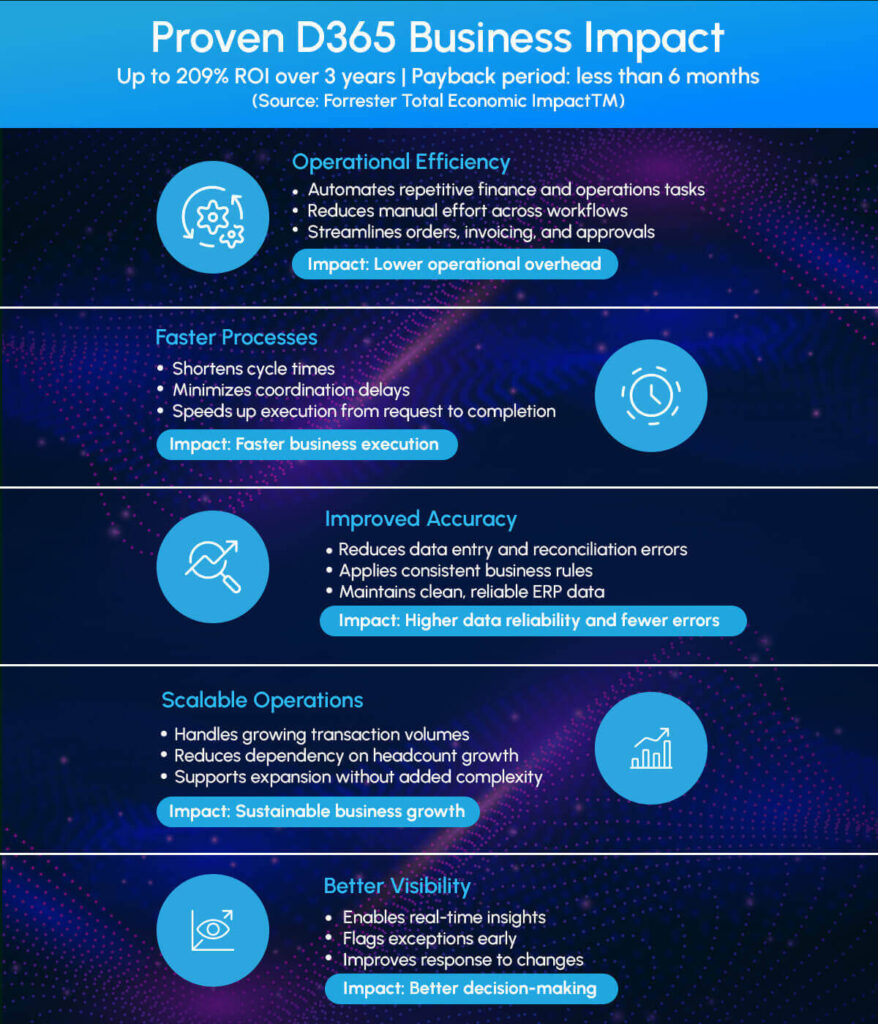
A Forrester Total Economic Impact study found that organizations using Dynamics 365 realized up to $3.9 million in infrastructure cost savings by moving from on-premises systems to the cloud.
For finance leaders, this means capital can be redirected toward growth instead of system maintenance.
Read more: Breaking Down Dynamics 365 Business Central Essentials, Premium, and Team Members Licensing
Conclusion
Scaling North American operations is not just a technology challenge; it is an operational one. Businesses that grow without losing control invest in systems built for complexity, not patched to manage it.
Microsoft Dynamics 365 Business Central stands out as a reliable ERP for scaling businesses and navigating North American expansion. It brings together cloud architecture, unified data, seamless Microsoft integration, automation, AI capabilities, and predictable economics in a single platform.
The question is not whether your ERP will hold you back. For many businesses, it already is. The right time to evaluate your options is before that gap becomes a constraint.
If you are evaluating D365 Business Central for your North American operations, let’s start with a conversation.
FAQs
D365 Business Central is designed for small to mid-market organizations and scales well for multi-entity, multi-currency, and multi-location operations. It is built to grow with your business.
Timelines vary; however, many mid-market deployments go live in 8 to 16 weeks with the right partner. More complex rollouts may take longer, often using a phased approach.
D365 Business Central supports multi-company management, intercompany transactions, multi-currency consolidation, and regional compliance across the US and Canada, all within a single system.
Copilot assists users within the system by answering questions and providing suggestions. AI Agents automate entire processes, such as order handling or invoice matching, with approvals where needed.
D365 Business Central uses a subscription model based on users and features. Costs scale as your business adds users, without large upfront infrastructure investments. Costs are not dependent on consumption or transaction volumes like other ERP systems that can increase rapidly in costs.
Keep reading

Ready to build smarter? Let's talk.
Our experts are ready to help you turn ideas into production-ready AI, cloud and digital solutions.
Get in touch →Let's Discuss Your Growth Strategy
Let's discuss how we can help you accelerate growth, improve efficiency, and drive real business outcomes.