 AI-First Culture
MuleSoft Integration Services: Why Businesses Are Making the Switch in 2026
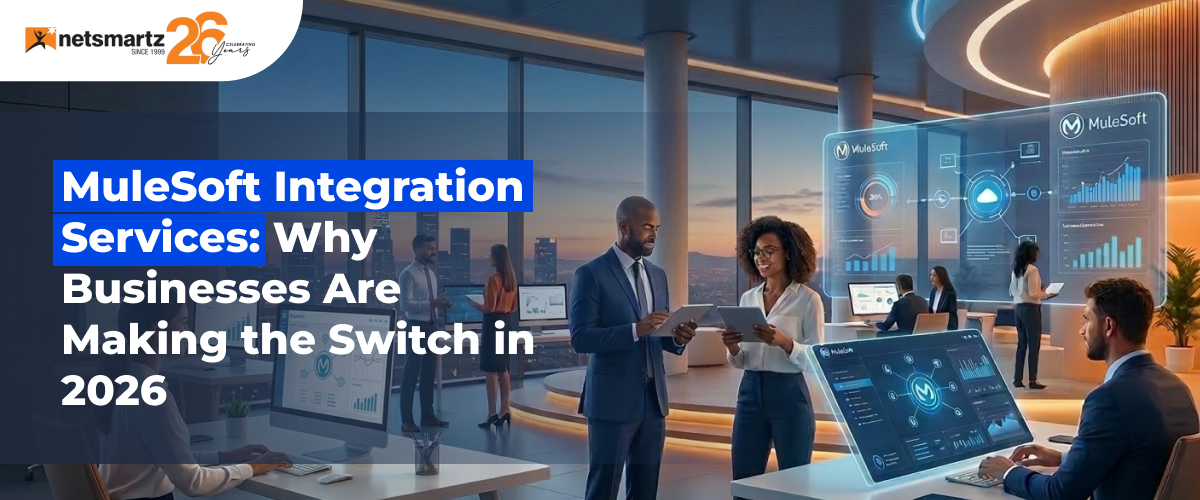
Here's a problem that's quietly costing businesses millions every year: the average enterprise now manages over 1,000 applications, but only 27% of them are connected to each other. That means 73% of your business data is sitting in silos, invisible to your teams, your CRM, and your AI tools.
This is exactly the problem MuleSoft integration services were built to solve. And in 2026, with AI agents, Agentforce, and real-time customer experiences becoming the standard businesses that can't connect their data are being left behind.
In this guide, we'll break down exactly what MuleSoft does, why businesses are switching to it from legacy integration tools, and how it positions your business for the AI-first future that's already here.
The Integration Crisis - By the Numbers
- 95% of organizations report facing challenges with data integration (MuleSoft 2026 Connectivity Benchmark Report)
- Only 27% of enterprise applications are currently connected - even among AI-ready companies
- 82% of IT leaders cite data integration as their biggest challenge when deploying AI
- 86% of IT leaders warn that without proper integration, AI agents add more complexity than value
- APIs and API-related implementations now account for 40% of company revenue - up from 25% in 2018
What Is MuleSoft?
MuleSoft is an integration platform owned by Salesforce that connects your business applications, data sources, and devices regardless of whether they live in the cloud, on-premise, or anywhere in between.
Its flagship product, the Anypoint Platform, acts as the central nervous system of your technology stack. Instead of building one-off connections between each system which quickly becomes an unmanageable web of brittle, expensive integrations - MuleSoft lets you build reusable APIs that connect everything through a single, governed platform.
Think of it this way: without MuleSoft, your tech stack looks like a tangled mess of direct wires between every system. With MuleSoft, everything connects through one clean, secure, and scalable integration layer.
MuleSoft's API-Led Integration Model
MuleSoft structures integrations into three layers of reusable APIs:
- System APIs - connect to your core systems (ERP, CRM, databases)
- Process APIs - orchestrate business logic across multiple systems
- Experience APIs - deliver data to the apps and users that need it
This architecture means every integration you build becomes a reusable asset - not a one-time, throwaway connection.
5 Reasons Businesses Are Switching to MuleSoft in 2026
1. They're Drowning in Data Silos
Point-to-point integrations - where each system connects directly to every other system - work fine when you have 5 or 10 applications. But the average enterprise manages over 1,000 apps. At that scale, point-to-point becomes a maintenance nightmare: fragile, expensive, and impossible to govern.
MuleSoft eliminates this by replacing the 'spaghetti architecture' of direct connections with a clean, API-led integration layer that any system can plug into. The result: data flows freely across your entire organization - in real time, securely, and without custom code for every connection.
2. Their AI Initiatives Are Blocked by Disconnected Data
This is the #1 reason businesses are accelerating their MuleSoft adoption in 2026. AI tools including Salesforce Agentforce - cannot deliver reliable results on fragmented, siloed data.
MuleSoft's new Agent Fabric capability allows businesses to connect, govern, and orchestrate AI agents across their entire enterprise, ensuring every AI tool has access to the complete, real-time data it needs to make accurate decisions. Without this integration layer, 86% of IT leaders warn, AI agents create more complexity than value.
3. Their Legacy Integration Tools Can't Keep Up
Many businesses are still running legacy middleware, custom ETL scripts, or outdated iPaaS tools that were built for a simpler technology landscape. In 2026, these tools have three critical weaknesses:
- No real-time data flow - legacy tools rely on batch processing, meaning your business runs on data that's hours or days old.
- No AI readiness - older integration platforms were not designed to connect AI agents or handle the unstructured data that modern AI requires.
- High maintenance cost - custom integrations-built years ago require constant developer attention to maintain, patch, and update as systems change.
MuleSoft's Anypoint Platform is purpose-built for the hybrid cloud, real-time, AI-first enterprise that businesses need to operate as in 2026.
4. They Need Faster Development and Delivery
MuleSoft's reusable API model delivers a compounding productivity advantage. Every integration you build becomes a reusable asset - meaning your second integration is faster than your first, and your tenth is faster than your fifth.
Businesses that have adopted MuleSoft report 57% faster development and delivery and a 74% reduction in maintenance effort and costs directly measurable business impact from the platform's reuse-first architecture.
5. They Need One Platform to Govern Everything
As regulatory requirements tighten and AI introduces new security and compliance challenges, businesses need a single control plane for all their integrations. MuleSoft provides:
- Centralized API governance - security policies, OAuth, rate limiting, and compliance checks applied universally at the API gateway layer.
- Full audit trails - every data flow is logged, monitored, and traceable - critical for GDPR, HIPAA, SOC 2, and industry-specific compliance.
- AI agent security - MuleSoft's Q1 2026 roadmap explicitly addresses AI agent identity and security challenges, ensuring agents can securely interact with downstream services.
MuleSoft vs. The Alternatives: How It Compares
| Factor | Point-to-Point / Custom Code | MuleSoft Anypoint Platform |
|---|---|---|
| Setup Speed | Fast for first integration | Slightly longer upfront, much faster at scale |
| Scalability | Breaks down past 20-30 integrations | Built for 100s to 1,000s of integrations |
| Maintenance Cost | High - every change breaks connections | Low — reusable APIs reduce ongoing work by 74% |
| AI Readiness | Not designed for AI agent connectivity | Built-in Agent Fabric for multi-agent enterprise |
| Real-Time Data | Batch processing only | Event-driven, real-time data flow |
| Governance | No central control - shadow IT risk | Single control plane for all integrations |
| Salesforce Integration | Custom connectors needed | Native Salesforce connector - seamless |
| Development Speed | Fast start, slows dramatically over time | 57% faster development over time |
Also Read: The Hidden Power of MuleSoft Integration Solutions That Most Enterprises Miss
Is MuleSoft Right for Your Business?
MuleSoft is not a one-size-fits-all solution. Here's an honest guide to who benefits most:
| Business Type | Should You Consider MuleSoft? |
|---|---|
| Enterprise (500+ employees, 50+ applications) | Yes - MuleSoft is built for this complexity level |
| Mid-market (100–500 employees, growing fast) | Yes - deploy now before complexity compounds |
| Salesforce-heavy business (multiple clouds) | Yes - MuleSoft is the native Salesforce integration layer |
| Business deploying Agentforce or Einstein AI | Yes - MuleSoft is the recommended AI integration backbone |
| SMB (under 50 employees, under 10 applications) | Maybe - native Salesforce connectors may be sufficient for now |
| Business on legacy middleware planning to modernize | Yes - MuleSoft is the industry-standard replacement |
Real Business Results from MuleSoft Deployments
| Business | Result |
|---|---|
| AT&T | Connected 50+ systems, saved 2 million work hours annually, accelerated time to market by 8x |
| University client | Reused 87% of APIs, boosted developer productivity by 40% |
| M1 Telecom | Reduced 150 apps to 30, accelerated time-to-market by 25% |
| Bayer Crop Science | Doubled product development speed, increased speed to market by 5x |
| RBC Wealth Management | Delivered fully digital customer experience 3x faster |
How Envision Helps You Implement MuleSoft
As a certified Salesforce integration services partner, Envision specializes in end-to-end MuleSoft implementation for growing businesses across the USA. Our approach:
- Integration Audit - We map your current tech stack, identify all data silos, and prioritize integration opportunities by business impact.
- API Strategy Design - We design your API-led integration architecture using MuleSoft's three-layer model - built for reuse and long-term scale.
- Phased Implementation - We deploy integrations in priority order - highest-value connections first so you see ROI from week one.
- Agentforce Readiness - For businesses deploying Salesforce AI, we configure MuleSoft as the integration backbone to ensure your AI agents have complete, real-time data access.
- Training & Handover - Your team learns to manage and extend the integration layer independently - no long-term dependency on external consultants.
The Bottom Line
The businesses winning in 2026 are not the ones with the most applications - they're the ones whose applications actually talk to each other. MuleSoft integration services turn your disconnected tech stack into a unified, AI-ready data platform.
Whether you're trying to eliminate data silos, accelerate your Agentforce deployment, replace legacy middleware, or simply make your business data work harder - MuleSoft is the platform purpose-built for that job.

Frequently Asked Questions
- Is MuleSoft only for large enterprises? MuleSoft has historically been associated with enterprise deployments, but the platform has expanded significantly in 2025-2026 with more accessible pricing tiers and low-code tools. Mid-market businesses deploying multiple Salesforce clouds, ERP systems, and third-party applications are now strong MuleSoft candidates.
- How does MuleSoft connect with Salesforce? MuleSoft is owned by Salesforce and has a native, pre-built connector for the entire Salesforce ecosystem - Sales Cloud, Service Cloud, Marketing Cloud, Data Cloud, and Agentforce. This makes it the fastest and most reliable way to connect Salesforce to any external system.
- How long does a MuleSoft implementation take? The timeline depends on the scope. A focused single-integration project can go live in 4-6 weeks. A full enterprise integration platform with 10+ connected systems typically takes 3-6 months in phased delivery. Starting with your highest-priority integration and expanding from there is the recommended approach.
- What's the difference between MuleSoft and Zapier? Zapier is a no-code automation tool built for simple, linear workflows between consumer apps. MuleSoft is an enterprise integration platform built for complex, high-volume, bidirectional data flows across large technology stacks. Zapier is great for automating a marketing workflow. MuleSoft is what you use to connect your ERP, CRM, data warehouse, supply chain, and AI agents at enterprise scale.
Keep reading

Ready to build smarter? Let's talk.
Our experts are ready to help you turn ideas into production-ready AI, cloud and digital solutions.
Get in touch →Let's Discuss Your Growth Strategy
Let's discuss how we can help you accelerate growth, improve efficiency, and drive real business outcomes.